If your fleet works Málaga airport, part of your rides probably comes from a platform that does not know the passenger better than you do, but does keep their email, their review and their next booking. Until recently that was a reasonable trade: they brought the volume and you brought the car.
In 2026 the trade has changed shape, because those platforms are no longer mid-sized companies competing with each other. They are coming together in very few hands.
Four groups, almost all of the airport transfer
These are the moves that can be checked in public sources as of today:
- Uber and Blacklane. On 30 March 2026 Uber announced it is buying Blacklane, the premium chauffeur network that works with local fleets in more than 500 cities. Closing is expected before the end of the year and depends on the competition authorities.
- Uber and Expedia. Since June 2026, Expedia hotels are booked inside the Uber app and Uber rides inside the Expedia app.
- Expedia and CarTrawler. Expedia already owns CarTrawler, which sells the transfer and the rental car inside the flight booking of many airlines.
- HBX and Holiday Taxis. Hotelbeds, now the listed HBX Group, has owned Holiday Taxis since 2018.
- CMAC and Suntransfers. Suntransfers has belonged to CMAC Group since 2022, and CMAC in turn has belonged to ComfortDelGro, the Singapore transport group, since 2024.
How the airport transfer has been consolidating
1
2018
Hotelbeds (now HBX Group) buys Holiday Taxis.
2
2022
CMAC Group buys Suntransfers.
3
2024
ComfortDelGro, from Singapore, buys CMAC Group.
4
March 2026
Uber announces the purchase of Blacklane, pending competition review.
5
June 2026
Uber and Expedia each sell inside the other's app.
The passenger hardly notices: they still see a price and a car. A local fleet notices a lot, because each of those groups decides the price it offers you the ride at, who it offers it to first and what happens when something goes wrong.
What each one keeps: almost nobody publishes it
The simplest question a fleet can ask, how much the intermediary keeps from each transfer, is the one with the fewest answers.
- groups that publish how much they keep from each transfer they pass on to you
- 0 of 4
Blacklane, for example, explains in its partner help centre that it charges no commission: the partner sees the price offered for each ride and decides whether to accept it. That is true and fair as a mechanism, but Blacklane's margin sits in the gap between what the passenger pays and what you are offered, and that percentage is not public.
The figures that do circulate come from the press, and should be read for what they are:
What the intermediary keeps from each ride, as published
| Who and source | Percentage |
|---|---|
| Uber, VTC (press, 2019) | 25 % |
| Uber, Madrid taxi (press, 2019) | 12 % |
| GetTransfer, as it states | 5 % |
| GetTransfer, according to its drivers (from) | 30 % |
| TransfersManager when it brings the customer (published) | 15 % |
The comparison is not about who is expensive. It points at something more uncomfortable: if you do not know how much the intermediary keeps, you do not know what your customer is worth either.
Who keeps the customer
When you sell through a giant, the person who pays is its customer, not yours. That has three practical consequences:
- The data. The email and phone you receive are for doing the ride. Writing to that passenger again for their next trip is not allowed in most contracts, and even if it were, the passenger does not know who you are.
- The review. The passenger rates the platform. The big names in the sector hold between 50,000 and 87,000 reviews on Trustpilot; the fleet that did the ride adds none.
- The next booking. When the passenger comes back to Málaga, they open the same app. If that day the ride goes to another fleet, or the group changes its terms, you have no way of getting them back.
Selling through a giant or owning your channel
Through a large group
- Volume from day one
- No sales work for you
- It sets the price and its margin is not public
- The passenger, their review and their next booking are its own
- If another group buys it, the terms can change
Your own channel
- Demand and reviews take time to build
- You set the price
- The passenger and their review are yours
- You can offer them the next trip
- Nobody can change your rules by buying a company
The risk in the last line is not theoretical. Whoever works with Blacklane today signed with a Berlin company; if the purchase closes, in 2027 they will be working for Uber, and we do not know what terms they will have then.
What did happen with the small ones
A large intermediary has one advantage: it pays. At the other end are the small marketplaces that grew by signing up fleets without looking after any of them, and there the complaint repeated most in the reviews is not the passenger's, it is the carrier's:
- Jayride, listed in Australia: charges the passenger, pays the carrier later and keeps the difference. The dominant complaint in its reviews is carriers who are owed money.
- Intui: the dominant complaint is non-payment to suppliers, with a minimum of 70 euros accumulated before you can be paid.
- GetTransfer: states a 5 % commission; its drivers talk about 30 to 35 %, and about non-payment.
Our recommendation is to join none of the three. It is the line we already had with Jayride and GetTransfer, and now with Intui.
What to do if you already sell through one
An orderly way of not depending on anyone
Measure what each channel leaves you
Add up what you collected per channel last quarter and divide it by the rides. That is what one ride from each intermediary is worth to you.
Cap what comes in through a single door
If one channel passes half of your turnover, any change on its side is a change to your business.
Have a place where the passenger finds you
A website with a fixed price and instant booking, under your brand, for the passenger who returns and for the hotel that recommends you.
Pass and receive rides between fleets, with written rules
What you cannot cover goes to another fleet and you get your share; what another cannot cover comes to you.
Choose intermediaries that publish what they keep
A written percentage can be compared. A margin hidden in the price cannot.
Where TransfersManager stands in this picture
We are one of the options, not the answer to everything, so it is worth saying where we do not compete. We do not have Blacklane's worldwide coverage or CarTrawler's presence inside airline bookings, and we will not have them. What we do have, and publish:
- The fleet gets 85 % of every ride TransfersManager brings it, and it is settled automatically when the ride is completed.
- The Dispatch Pool: if a fleet cannot do a ride, another one picks it up and gets its share, under the rules set by whoever passes it on. It is explained in how to pass a ride to another operator.
- Your website under your brand with a fixed price, so the returning passenger finds you and not the platform. We cover it in living off a marketplace or owning your channel.
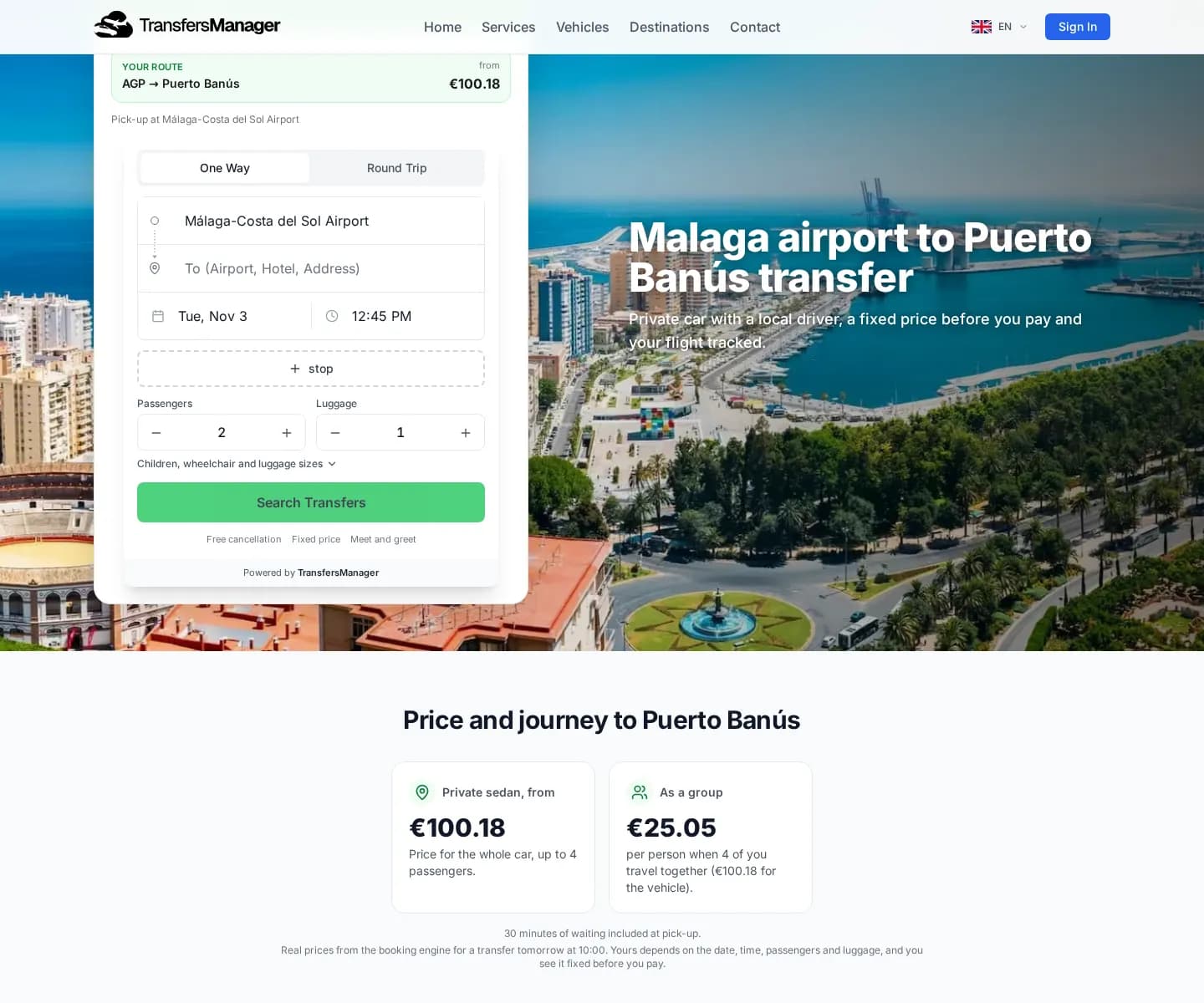
For the passenger, the page of each Costa del Sol route shows the booking engine's real price before paying, in sixteen languages, like the one for the airport transfer to Puerto Banús:
If you sell through a giant, let it be because it suits you that day, not because you have no other door.
Sources, checked on 3 November 2026. Uber's purchase of Blacklane: The Next Web, b2venture and TravelMole. Uber and Expedia: PhocusWire. Holiday Taxis: Skift (2018). Suntransfers: CMAC Group. Blacklane and its partners: Blacklane partner help centre. Uber commissions in 2019: El Independiente. GetTransfer: press release on PR Newswire. Jayride, Intui and reviews: each company's Trustpilot and Jayride's quarterly report on Financial Reports. Press figures come from third parties, not from the companies.